AC Repair in
Lake Jackson, TX —
24/7 Emergency Dispatch
Your AC goes out when it’s 98°F and climbing inside. We show up — with the right parts, an honest price before we touch anything, and a technician who actually knows what Gulf Coast salt air does to a capacitor. Flat diagnostic fee: $85–$160. No surprises.
Should You Call Tonight or Wait Until Morning?
Not every AC problem justifies waking up a technician at 2am and paying a $150–$250 after-hours surcharge. Use this checker to find out — based on actual safety criteria, not guesswork.
Local Technicians. No Franchise, No Houston Dispatch.
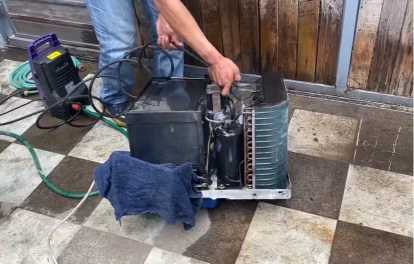
Our technicians bring the right tools to every call.
We are a Brazosport-area AC company. That distinction matters more here than it would in most Texas markets. The Gulf Coast has a specific set of problems that show up on a predictable cycle — condensate drain algae every 90 days instead of annually, salt-air capacitor failure in 3–7 years instead of 8–12, coil corrosion that does not appear on any inland diagnostic checklist. A Houston franchise driving south when they have nothing else scheduled does not build this knowledge. We have.
Nine miles from the Gulf of Mexico, Lake Jackson runs at 76% average relative humidity. That number is not background context — it directly determines your AC's failure schedule. At 76%, algae colonizes condensate lines faster than any technician trained for inland Texas will expect. Salt-laden air from the Gulf corrodes aluminum coil fins and copper tubing at a rate that shortens system life to 7–12 years against a manufacturer spec sheet written for 15–20. The technician who has not serviced Brazosport units does not know this from experience. The one who has, does.
We are not a general HVAC company that happens to be in the area. We are not a call center routing your call to whoever has availability. When you call after 10pm in August, a technician answers — not a voicemail, not an overnight answering service. We have operated this way since 2009, which is the only way to build the kind of reputation in a small market like Brazosport that lets you stay in business.
How We Operate
Why AC Units in Lake Jackson Break Down Faster Than the Spec Sheet Says
The manufacturer's warranty assumes your condenser is sitting in a backyard in Dallas. It is not. It's 9 miles from the Gulf of Mexico, in one of the most corrosive HVAC environments in Texas — and that changes everything about how you maintain it and when you replace it.
What the Gulf Coast Does to Your Equipment
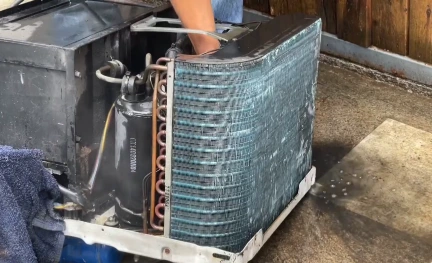
The aluminum fins on your outdoor condenser and the copper refrigerant tubing inside your evaporator coil sit in a salt-spray environment every single day. In the neighborhoods along Oyster Creek and anywhere south of FM 2004, that salt deposits on metal surfaces and accelerates electrochemical corrosion. Aluminum fins pit and flatten, reducing airflow. Copper refrigerant lines develop pinholes and leak R-410A.
This is why a Lake Jackson AC that was "running fine last summer" fails hard in June. The corrosion is cumulative. Year 7 looks like year 15 in Phoenix.
Run and start capacitors in coastal Texas typically fail in 3–7 years. In Dallas the same component lasts 8–12. It's not the brand. It's the zip code.
The Condensate Drain Problem Specific to 77566
At 76% average humidity, your AC's condensate drain runs constantly — removing gallons of moisture from the air every day. That moisture is a permanent growth medium for algae inside the PVC drain line. Manufacturer guidance says flush the drain annually. In Lake Jackson, it clogs in 90 days if untreated.
When the drain clogs, the float switch triggers — and your system shuts off. No visible malfunction. No error code. Just stops cooling. It looks like a major failure. It's usually an $85–$150 drain clearing.
How Lake Jackson's coastal environment compares to what the manufacturer spec sheet assumes:
| Component / System | Manufacturer Spec (Inland TX) | Lake Jackson Reality | Primary Cause |
|---|---|---|---|
| Full AC system lifespan | 15–20 years | 7–12 years | Salt air corrosion + continuous humidity cycling |
| Run capacitor (start/run) | 8–12 years | 3–7 years | Salt air degrades capacitor dielectric; coastal humidity |
| Condensate drain clearing | Once per year | Every 90 days | 76% avg humidity accelerates algae growth year-round |
| Evaporator coil inspection | Every 5–7 years | Every 3–4 years | Formicary corrosion from salt air; coastal humidity |
| Contactor replacement | 7–10 years | 5–8 years | Coastal humidity pits contact points faster |
| Coil fin corrosion onset | 10+ years inland | 3–5 years (within 2 mi of Gulf) | Airborne salt deposits on aluminum fins |
| Annual tune-up frequency | Once per year | Twice per year (pre-season + Sept) | Length and severity of Gulf Coast cooling season |
What Is Your AC Telling You?
Gulf Coast conditions create failure patterns that do not appear on a generic HVAC troubleshooting chart. At 76% average humidity, your condensate drain clogs on a 90-day cycle. Salt air from the Gulf corrodes capacitors and coil fins on a timeline that would surprise most inland technicians. The table below maps symptoms to likely causes — and tells you how fast to act.
| Symptom | Likely Cause | Urgency |
|---|---|---|
| AC runs but blows warm air | Refrigerant leak or failed capacitor | Today |
| Unit hums but won't start | Failed capacitor or contactor | Today |
| System shuts off — no visible cause | Condensate drain clog / float switch tripped | Today |
| Ice on refrigerant line | Low refrigerant or blocked airflow | Call Now |
| Water pooling near air handler | Drain overflow or drain pan crack | Today |
| Outdoor unit completely silent | Contactor failure or power issue | Today |
| Very low airflow from vents | Blower motor failing or clogged filter | This Week |
| Loud banging / grinding outdoor | Compressor failure or loose component | Call Now |
| Musty smell from vents | Algae in drain pan / biofilm buildup | This Week |
| Electric bill spike — no usage change | Refrigerant loss or efficiency drop | This Week |
| Short cycling — on/off rapidly | Refrigerant issue or thermostat failure | Today |
| Burning or electrical smell | Electrical issue — potential fire hazard | Call Now |
| Breaker trips when AC starts | Hard-start compressor electrical failure | Call Now |
| Brown water from drain pan | Pan corrosion — common in coastal units | This Week |
The 7 Most Common AC Repairs in Brazosport Area Homes
Every repair call we take in Lake Jackson and Clute falls into one of these categories. Know the symptoms, the likely cause, and the realistic cost before you pick up the phone.
Capacitor Failure — The #1 Call We Receive
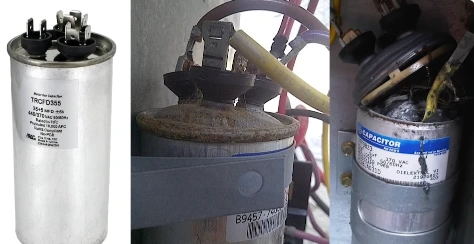
Run and start capacitors degrade faster in coastal conditions. Salt air and heat cycling push them below their rated microfarad value in 3–7 years — compared to 8–12 years inland. When the run capacitor fails, the compressor or condenser fan loses the electrical kick it needs to start.
Symptoms to watch for:
- Outdoor unit hums but won't start
- Condenser fan not spinning, compressor making low hum
- System starts then clicks off within 30 seconds
- AC running but blowing warm air with no cooling
Most capacitor replacements finish in under an hour. If you're in a house built before 2015 in Lake Jackson and your AC has never had a capacitor replaced, it's statistically due.
Refrigerant Leak — Coil Corrosion
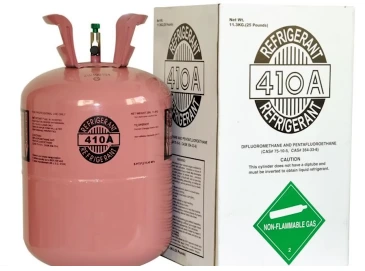
Salt air causes formicary corrosion in copper evaporator coils — microscopic pits that eventually pinhole and release refrigerant. R-410A loss reduces cooling capacity and forces the compressor to run longer at higher temperatures, accelerating its wear.
Symptoms:
- AC runs constantly but never cools below 78°F
- Ice forming on the refrigerant line or evaporator coil
- Hissing or bubbling sound near the air handler
- Electric bill climbs despite no change in use
Clogged Condensate Drain Line
In Lake Jackson's 76% humidity, algae colonizes the condensate drain year-round. The drain line runs from your air handler's drip pan through a PVC trap and out through a wall or outside. When algae blocks it, the drip pan overflows — or the float safety switch cuts power to the system.
Symptoms:
- System shuts off with no visible cause
- Water pooling near the indoor air handler
- Musty smell from vents (biofilm in the drain pan)
- Drain gurgling or bubbling sounds
DIY prevention: Pour 1 cup of plain white vinegar into the condensate drain access port (the T-fitting near your air handler) every 90 days. Don't use bleach — it degrades PVC and gaskets over time.
Contactor Failure
The contactor is a relay switch in the outdoor disconnect box that completes the circuit to the compressor and condenser fan when your thermostat calls for cooling. Heat, humidity, and thousands of electrical cycles per season pit and weld the contact points. When it fails, the outdoor unit won't engage — or won't disengage and runs nonstop.
Symptoms:
- Outdoor unit completely silent when thermostat calls for cooling
- Indoor air handler running but no outdoor response
- Outdoor unit running constantly, even when thermostat is satisfied
- Chattering or buzzing sound from the outdoor disconnect
Blower Motor Failure
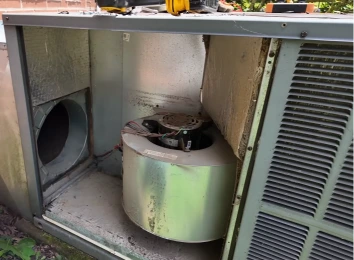
The blower motor inside your air handler moves conditioned air through the evaporator coil and into your duct system. Bearings fail from long run cycles — in Lake Jackson, the AC runs 8–12 months a year versus 4–6 months inland. A failing blower motor reduces airflow first, then fails entirely.
Symptoms:
- Air coming from vents is barely moving (reduced CFM)
- High-pitched squeal or grinding from the air handler cabinet
- System runs but rooms never reach set temperature
- Burning smell from the air handler during startup
Frozen Evaporator Coil
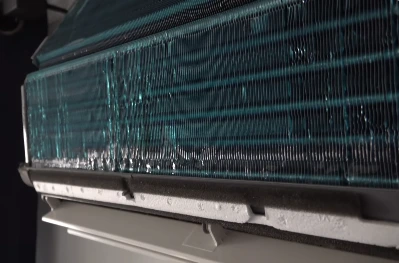
A frozen evaporator coil is always a symptom, not a root cause. Ice forms when refrigerant is low (from a leak) or when airflow drops below the coil's minimum — usually from a clogged filter or failing blower motor. The coil must completely thaw (2–4 hours with the fan on, system off) before we can diagnose the underlying problem.
Symptoms:
- Ice visible on the refrigerant line or indoor coil
- AC running nonstop with no cooling
- Water dripping from the air handler after shutdown
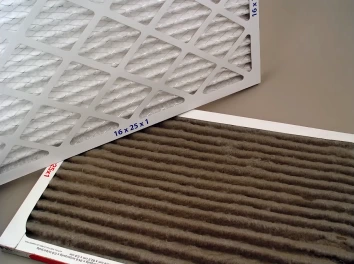
First step: Turn the system to FAN ONLY (not OFF, not COOL) and let it thaw. Change the filter. If it refreezes after thawing, you have a refrigerant leak or a blower problem — call us.
Compressor Failure
The compressor is the heart of your refrigeration cycle — it pressurizes the refrigerant that moves heat from inside your home to outside. In coastal Texas, compressors reach end-of-life around years 8–12. At that repair cost, full system replacement is often the financially sound decision — especially if the system uses R-22.
Symptoms:
- Loud banging, grinding, or rattling from outdoor unit
- Circuit breaker tripping when AC starts
- System running but no cooling — refrigerant not circulating
- Hard start — takes multiple attempts to come on
What AC Repair Costs in Lake Jackson —
Every Common Service
No contractor in the Brazosport area publishes a complete pricing table. We do, because you shouldn't have to guess what a repair costs before you decide whether to call. These are real 2026 ranges based on typical repair scenarios in the 77566 area.
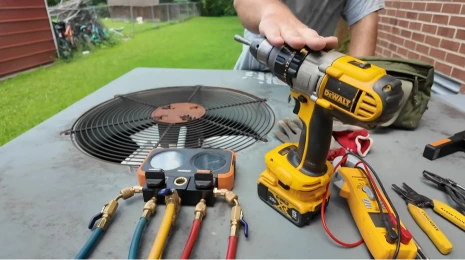
We check refrigerant pressure and 12-point system diagnostics on every call.
| Service / Repair Type | What It Involves | Price Range (2026) | Time Estimate |
|---|---|---|---|
| Diagnostic Fee required | Full system inspection, fault identification, written quote before any repair begins | $85 – $160 | 45–75 min |
| Run Capacitor Replacement most common | Single-run capacitor replaced; compressor or fan motor tested post-install | $150 – $260 | 45–60 min |
| Dual Run Capacitor Replacement | Dual-run capacitor (powers both compressor and fan) replaced | $180 – $300 | 45–60 min |
| Contactor Replacement | Outdoor contactor relay replaced, wiring inspected, tested under load | $150 – $350 | 1–1.5 hrs |
| Condensate Drain Clearing | Vacuum flush of drain line, trap inspection, algae treatment applied | $85 – $150 | 30–45 min |
| Refrigerant Recharge — R-410A | System leak checked, refrigerant added to spec, superheat and subcooling verified | $300 – $600 | 1.5–2.5 hrs |
| Refrigerant Recharge — R-22 | R-22 systems only (pre-2010). R-22 is no longer manufactured; supply is limited | $400 – $900+ | Varies |
| Blower Motor Replacement | ECM or PSC blower motor replaced in air handler; duct static tested post-install | $400 – $700 | 2–3 hrs |
| Evaporator Coil Repair / Leak Seal | Pinhole repair with injectable sealant if coil is otherwise intact | $300 – $600 | 2–3 hrs |
| Evaporator Coil Replacement | Full coil replacement — required when corrosion is extensive. System recharged after | $1,000 – $2,500 | 4–6 hrs |
| Compressor Replacement | OEM or aftermarket compressor installed; system fully evacuated and recharged | $1,500 – $3,500 | 4–8 hrs |
| Thermostat Replacement | Programmable or smart thermostat installed; system calibrated | $120 – $350 | 45–90 min |
| AC Tune-Up / Preventive Maintenance | Coil cleaning, capacitor check, refrigerant level, drain flush, filter, electrical inspection | $90 – $175 | 1–1.5 hrs |
| Emergency After-Hours Dispatch Surcharge | Applied to calls dispatched after 8pm, weekends, and holidays — in addition to repair cost | $150 – $250 | — |
What the $5,000 Rule Means for Lake Jackson Homeowners
Multiply the proposed repair cost by your system's age in years. If the result exceeds $5,000, replacement is typically the better long-term financial decision. Example: $600 repair × a 9-year-old system = $5,400 → replacement makes sense, especially in coastal conditions where the next failure often comes within 18 months of the previous one.
Every common repair type, what it involves, and the 2026 price range for Brazosport area service calls:
| Repair Type | What It Involves | 2026 Price Range | Avg Time |
|---|---|---|---|
| System Diagnostic | Full system inspection, readings, written quote | $85–$160 | 45–90 min |
| Capacitor Replacement MOST COMMON | Run or start capacitor; includes µF verification | $150–$300 | 30–60 min |
| Contactor Replacement | Outdoor unit relay switch; contact point inspection | $175–$325 | 45–75 min |
| Condensate Drain Clearing | Vacuum flush, algaecide treatment, float switch test | $85–$175 | 30–60 min |
| Refrigerant Recharge (R-410A) | Leak check, recharge to spec, superheat/subcooling verify | $300–$600 | 60–120 min |
| Refrigerant Recharge (R-22) | Recharge only — no longer recommended (see R-22 note) | $400–$900+ | 60–90 min |
| Blower Motor Replacement | ECM or PSC motor; includes run test and amp draw check | $400–$700 | 2–3 hrs |
| Evaporator Coil — Sealant Repair | Electronic leak detection, injectable sealant, recharge | $350–$600 | 2–3 hrs |
| Evaporator Coil — Full Replacement | Full coil swap; system evacuation, recharge, verify | $1,000–$2,500 | 4–6 hrs |
| Condenser Coil Replacement | Outdoor coil; includes coil cleaning option vs replacement | $900–$2,200 | 3–5 hrs |
| Compressor Replacement | Compressor swap; system flush, new drier, full recharge | $1,500–$3,500 | 4–8 hrs |
| TXV Replacement | Thermostatic expansion valve; includes superheat calibration | $350–$700 | 2–4 hrs |
| Float Switch Replacement | Condensate safety switch; includes drain line inspection | $85–$175 | 30–60 min |
| Emergency After-Hours Surcharge | Applied to any call dispatched outside standard hours | $150–$250 | — |
Technician Certifications
- NATE Certified — North American Technician Excellence, the industry's highest standard for HVAC competency. Requires passing written exams in specific specialty areas.
- EPA 608 Certified — Required by federal law for anyone handling refrigerants (R-410A, R-22, R-454B). Not every contractor you find online carries this.
- Carrier, Trane, Lennox Factory Training — Brand-specific training on diagnostics, warranty repairs, and system commissioning for major manufacturers.
Insurance & Legal Compliance
- General Liability Insurance — Covers property damage during service. Ask for a certificate of insurance before any contractor enters your home.
- Workers' Compensation — Covers technician injury on your property. Without it, a technician injured in your home can become your liability.
- Fully Bonded — Additional financial protection for customers.
- Compliant with Texas Department of Licensing & Regulation (TDLR) requirements.
Gulf Coast-Specific Experience
- Condensate drain maintenance protocols specific to 76% humidity environments
- Coastal coil corrosion assessment and fin protection treatment
- Hurricane Harvey surge damage diagnosis — compressor winding resistance testing
- R-22 to R-410A / R-454B system transition experience
- Knowledge of which Lake Jackson neighborhoods still carry R-22 equipment
- Brazosport shift-worker scheduling — we work around plant rotation schedules
What We Don't Do
- No commission-based technicians — Techs aren't paid more for selling more. They're paid for accurate diagnosis.
- No "free estimates" that become invoices — Our diagnostic fee is disclosed upfront. That's what you pay to have someone show up and look.
- No recommending replacement on repairable systems — We present both options with honest math.
- No vague phone estimates — We won't quote a repair without inspecting the system first. Any contractor who does is guessing.
What you can safely handle yourself — and what requires a licensed TACLB technician:
| Task | Who Does It | Why |
|---|---|---|
| Change the air filter | ✓ DIY | No tools, no risk. Check monthly in Gulf Coast summer. |
| Pour white vinegar in condensate access | ✓ DIY | Standard prevention. 1 cup every 90 days in Lake Jackson conditions. |
| Check and reset tripped breaker (once) | ✓ DIY — once | If it trips again, call. Repeated trips indicate compressor electrical failure — do not keep resetting. |
| Clear debris from outdoor unit | ✓ DIY | Keep 18 inches of clearance. Do not hose the unit — use a brush. |
| Check thermostat settings and batteries | ✓ DIY | Thermostat in "cool" mode, set below current indoor temp. Battery check first. |
| Verify condensate float switch reset | ✓ DIY — with care | If drain line was recently cleared, press the float switch reset. If system does not start, the line is still blocked — call. |
| Add refrigerant | ✗ Licensed Tech | Requires EPA 608 certification. Incorrect charge causes compressor damage. Refrigerant handling is federally regulated. |
| Replace a capacitor | ✗ Licensed Tech | Capacitors hold lethal charge after power is disconnected. Incorrect µF rating causes motor failure. |
| Replace a contactor | ✗ Licensed Tech | 240V wiring at the disconnect. Incorrect wiring causes compressor failure or fire. |
| Clean evaporator coil | ✗ Licensed Tech | Incorrect cleaning agent causes formicary corrosion. Coil access requires system shutdown and evacuation procedure. |
| Flush condensate drain with shop vac | ✓ DIY — carefully | Attach shop vac to the exterior condensate drain outlet. Clear clogs if accessible. If system still does not restart, call — the trap may need professional clearing. |
| Any electrical wiring inside the unit | ✗ Licensed Tech | Texas law requires TACLB licensure for HVAC electrical work. This includes thermostat wiring beyond simple wire reconnection. |
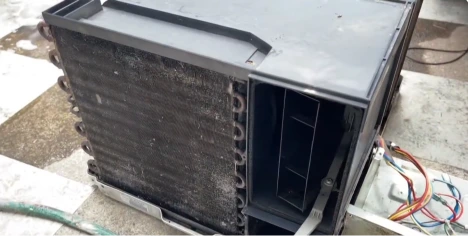
| Inspect outdoor coil fins | ✓ DIY | Look for bent or corroded fins through the unit grille. Salt-air corrosion will appear as grey pitting. Report what you see — do not attempt to straighten fins without a fin comb. |
How We Compare to Other AC Companies in Brazosport
Before you call any AC contractor in the Brazosport area, ask them three things: Can I verify your TACLB license number right now? What is the diagnostic fee and when do I pay it? Do your technicians earn commission on what they sell me? The answers tell you everything. Here is how we compare to what you will typically find.
| What Matters | Us | Most Brazosport Contractors |
|---|---|---|
| TACLB License — verifiable | ✓ Licensed & Insured | Varies — always ask before scheduling |
| Commission-based technicians | ✓ Never — techs earn a salary | Common practice — 10–15% sales commission |
| Written quote before work starts | ✓ Always — you approve first, then we work | Often hourly or estimated range, not written |
| Diagnostic fee disclosed upfront | ✓ Yes — $85–$160, stated before dispatch | Often not disclosed until technician is on-site |
| Parts on truck — same-day repair | ✓ Yes — most common parts stocked | Often requires supply house run, adds delay |
| 24/7 real person answers | ✓ Yes — technician answers, not a call center | Voicemail or answering service after hours |
| Gulf Coast specialist knowledge | ✓ Yes — serving Brazosport since 2009 | Houston companies driving south when available |
| Written warranty on completed work | ✓ Yes — written before we leave the job | Verbal only, or no warranty stated |
| Emergency after-hours surcharge disclosed | ✓ Yes — $150–$250, stated before dispatch | Often a surprise on the final invoice |
3 Real Jobs. Real Brazosport Homes.
Diagnosis, method, cost, outcome. Not stock photos, not testimonials.
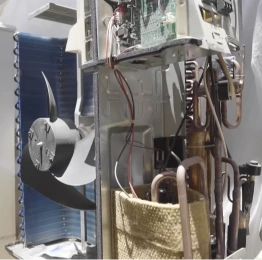
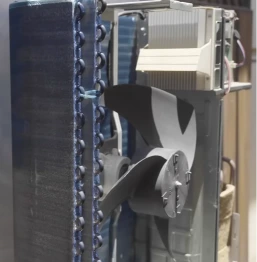
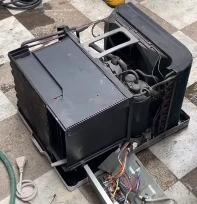
Before & After — Real Lake Jackson and Brazosport Service Calls
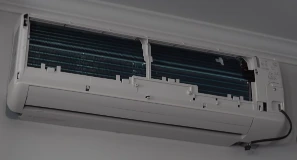
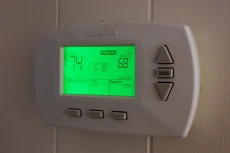
All photos below are from actual service calls in Lake Jackson, Freeport, Clute, and Richwood. Gulf Coast conditions produce failure patterns that look different from what you will find in any generic HVAC photo library.
No Surprises — Here's Exactly What Happens
A Lake Jackson homeowner who works at the plant knows what a clear process looks like. Here's ours, start to finish — so you know what you're agreeing to before you call.
You Call or Text — a Technician Answers
Not a call center. Not an answering service. If we're dispatched, we're actually dispatched. We confirm your address (Lake Jackson, Clute, Freeport, Richwood, or surrounding area), your symptoms, and give you a realistic arrival window. Emergency calls are prioritized — no "next available appointment" for a system-down situation in July.
We Diagnose — Flat Diagnostic Fee, No Guessing
The technician inspects the full system: capacitor microfarad readings, refrigerant pressures, amperage draws, condensate drain, evaporator coil, filter, thermostat communication. We don't recommend what we haven't measured. Flat diagnostic fee: $85–$160 — you know this before we arrive.
We Give You the Quote in Writing — Before We Touch Anything
After diagnosis, you get a written repair quote with the exact cost. Not a range. Not "around." The number. If there's more than one option (repair the coil vs. replace it), we explain both, including the honest long-term math. You decide. No pressure. No "I'm already here, so might as well."
We Do the Repair — With Parts on the Truck
Our trucks carry the most common failure parts for Lake Jackson homes: run and dual-run capacitors (multiple µF ratings), contactors, condensate drain fittings, refrigerant (R-410A and R-454B), and basic control board components. Most calls are completed on the first visit. We don't leave and come back for a capacitor.
System Tested Before We Leave
After repair, we run the system through a full cooling cycle: verify supply air temperature differential (typically 18–22°F below return air in cooling mode), check refrigerant pressures, confirm drain flow, measure amperage on repaired components. We don't leave until it's confirmed working and you're satisfied.
When AC Problems Happen in Lake Jackson — By Season
Brazosport's climate creates a predictable pattern of failures across the year. Knowing when to expect problems — and what to watch for — is the difference between a $125 drain clearing and a $1,500 emergency call.
The most common April call: system ran fine last fall, won't cool today. Usually a capacitor that crossed the failure threshold over winter.
After-hours calls spike in this window. If your system fails after 8pm in August, the $150–$250 after-hours surcharge applies. The honest math: a tune-up in May costs less than one after-hours July call.
Systems that ran hard all summer and have been making new noises since August need to be looked at now — before next May when wait times for a technician get longer.
This is the best window for replacement planning: equipment lead times are shorter, installation crews are available, and you choose your system without the pressure of a 98°F weekend. If the $5,000 Rule pointed toward replacement during your last repair call, now is the time to act on it.
Emergency or Can It Wait?
If you're reading this at 11pm and your AC just stopped, use this table before you decide whether to call the after-hours line — and add $150–$250 to your repair cost:
| Situation | Act When | Why |
|---|---|---|
| Burning or electrical smell | Call Now | Fire / electrical hazard — shut off system, do not reset anything |
| Gas smell near HVAC equipment | Call 911 First | Leave property immediately — call from outside, not from inside the home |
| Water actively flooding from air handler | Call Now | Structural and electrical risk — shut off system breaker first |
| Breaker trips more than once today | Call Now | Compressor electrical failure — do not keep resetting the breaker |
| Loud banging from outdoor unit | Call Now | Compressor damage worsens with each restart — shut off and call |
| Indoor temp 85°F+ — elderly, children, or pets present | Call Now | Heat health risk — Gulf Coast humidity makes this threshold lower than it looks |
| Outdoor unit silent — no cooling at all | Tonight / Tomorrow | Contactor or capacitor — urgent but not a safety issue |
| Warm air — system running but not cooling | Tomorrow Morning | Refrigerant or capacitor — call at opening, not midnight unless temp is critical |
| System shuts off randomly | Tonight or Tomorrow | Drain clog likely — manageable if indoor temp is still tolerable |
| Water pooling — small amount near air handler | Tomorrow | Drain overflow — not an emergency but do not ignore for more than 24 hours |
| Musty smell from vents | This Week | Algae in drain pan — schedule within 7 days, not an after-hours call |
| Low airflow from vents | This Week | Change filter first — if that does not improve it, schedule a service call |
| High electric bill, no change in usage | This Week | Efficiency loss — schedule a tune-up, not an emergency call |
| Minor rattling from outdoor unit | This Week | Loose panel or debris — inspect before calling; remove visible debris first |
Repair or Replace? How to Make the Right Call in Lake Jackson
Every AC repair conversation eventually hits the same question: is it worth fixing, or is it time to replace it? There is a simple framework that gives you an honest answer before you spend anything: the $5,000 Rule. Multiply the proposed repair cost by your system's age in years. If the result is over $5,000, replacement is typically the better long-term financial decision. If it is under $5,000, repair usually makes sense — as long as the root cause is addressed, not just the symptom.
In coastal Gulf Coast conditions, apply this rule more aggressively than you would for a Dallas home. A 9-year-old Lake Jackson system has experienced the equivalent of 13–15 years of inland Texas wear — salt-air corrosion, 76% humidity cycling, and one of the longest effective cooling seasons in the state all accelerate component degradation. When a coastal system reaches the borderline zone ($4,000–$6,000 score), we lean toward replacement. The next failure typically comes within 12–18 months of a major repair on a system at this age in this environment.
| Repair Quote | System Age | Score | Decision |
|---|---|---|---|
| $300 | 7 years | $2,100 | Repair makes sense — system has years left |
| $500 | 5 years | $2,500 | Repair — system is relatively new |
| $600 | 9 years | $5,400 | Borderline — get a full system assessment first |
| $800 | 8 years | $6,400 | Lean toward replacement — assess total system condition |
| $1,800 | 10 years | $18,000 | Replace — clear answer at any coastal age |
Reviews from Real Calls in 77566 and Surrounding Areas
Reviews with specific technician names, problem descriptions, and repair outcomes build more trust than star ratings alone. Here's what people in Lake Jackson, Clute, and Freeport say about calls we've handled.
"AC stopped blowing cold around 9pm on a Friday in July — 94° outside, two kids in the house. Called and Marcus picked up directly. He was at our place in Oyster Creek within 40 minutes, had the run capacitor on his truck, and we were cooling again by 11pm. Total came to $235 including the after-hours call. Exactly what he quoted before he started."
"I fully expected them to try to sell me a new unit — my Carrier is 11 years old. Instead, the tech (Danny) checked the capacitor µF rating, said it was still within spec, and traced the actual problem to a corroded contactor. Fixed it for $280, told me the compressor still had 2–3 years in it if I keep up on maintenance. I appreciated the honesty more than the price."
"System shut off out of nowhere — no error codes, no obvious problem. Tech named Carlos diagnosed a clogged condensate drain float switch before he even opened the unit. Said it's the number one call they get in Lake Jackson because of the humidity. Cleared it in 25 minutes, showed me how to flush it myself with vinegar every 90 days. $95 service call. Really glad I didn't panic and buy a new unit."
We Service Lake Jackson and Surrounding Communities
We're based in the Brazosport area — not a Houston company that drives an hour south when they have nothing else on the schedule. Average dispatch time to Lake Jackson 77566 is under 45 minutes.
What Makes Us Worth Trusting — Not Just Claiming
Anyone can put "24/7 emergency service" on a website. These are the verifiable credentials that separate a licensed, trained technician from someone with a van and a YouTube channel.
Technician Certifications
- NATE Certified — North American Technician Excellence, the industry's highest standard for HVAC competency. Requires passing written exams in specific specialty areas.
- EPA 608 Certified — Required by federal law for anyone handling refrigerants (R-410A, R-22, R-454B). Not every contractor you find online carries this.
- Carrier, Trane, Lennox Factory Training — Brand-specific training on diagnostics, warranty repairs, and system commissioning for major manufacturers.
Insurance & Legal Compliance
- General Liability Insurance — Covers property damage during service. Ask for a certificate of insurance before any contractor enters your home.
- Workers' Compensation — Covers technician injury on your property. Without it, a technician injured in your home can become your liability.
- Fully Bonded — Additional financial protection for customers.
- Compliant with Texas Department of Licensing & Regulation (TDLR) requirements.
Gulf Coast-Specific Experience
- Condensate drain maintenance protocols specific to 76% humidity environments
- Coastal coil corrosion assessment and fin protection treatment
- Hurricane Harvey surge damage diagnosis — compressor winding resistance testing
- R-22 to R-410A / R-454B system transition experience
- Knowledge of which Lake Jackson neighborhoods still carry R-22 equipment
- Brazosport shift-worker scheduling — we work around plant rotation schedules
What We Don't Do
- No commission-based technicians — Techs aren't paid more for selling more. They're paid for accurate diagnosis.
- No "free estimates" that become invoices — Our diagnostic fee is disclosed upfront. That's what you pay to have someone show up and look.
- No recommending replacement on repairable systems — We present both options with honest math.
- No vague phone estimates — We won't quote a repair without inspecting the system first. Any contractor who does is guessing.
All Major HVAC Brands Serviced in Lake Jackson and Brazosport Area
We work on every major residential and light commercial system installed in the 77566 area — including older Carrier and Trane units common in Dow Chemical-era homes built in the 1960s–1980s.
AC Repair Questions — Straight Answers for Lake Jackson Homeowners
The questions Lake Jackson homeowners actually search before calling an AC contractor — answered directly, without filler.
The diagnostic fee covers the technician's time to fully inspect and identify the problem. We apply it toward the repair total in most cases when you approve work. Every contractor in Brazoria County charges some form of diagnostic fee — anyone who claims a "free estimate" for a system failure is either building the cost into the repair or will find a reason to charge it once they're at your door.
For a full cost breakdown by repair type, see our pricing table above.
The coastal environment degrades aluminum condenser fins and copper refrigerant tubing at 2–3× the rate of systems in inland Texas cities. A Carrier or Trane unit that would reach 18 years in Dallas will typically need replacing at year 9–11 in Lake Jackson.
Three factors extend your system's life in this climate: annual professional coil cleaning to remove salt deposits, consistent condensate drain maintenance every 90 days to prevent backpressure damage, and keeping refrigerant charge within spec to avoid compressor overheating.
In Lake Jackson's summer heat — with a heat index regularly exceeding 107°F — an overnight AC failure with children or elderly residents in the home is a genuine emergency. We treat it as one.
When you call after hours: we'll confirm your address and system symptoms, give you an estimated arrival window, and state the emergency surcharge. You decide whether to proceed before we dispatch.
Your AC removes gallons of moisture from the air daily in Brazosport conditions. That moisture flows through a PVC drain line with a P-trap — exactly the conditions algae thrives in. At 76% humidity, the line is warm and constantly wet.
Most manufacturers recommend annual drain maintenance. That's for Phoenix. In Lake Jackson, treat it every 90 days as a routine task, the same way you change a filter. Use white vinegar, not bleach — bleach accelerates PVC degradation and corrodes rubber gaskets.
If your system shut off with no obvious cause and no error code, check the condensate drain first before calling. It's often a $0 fix (plunger or vinegar flush) or an $85–$150 service call.
Three other factors push toward replacement for Lake Jackson homes specifically:
- R-22 systems (pre-2010): If your 10-year-old system uses R-22, recharge costs $80–$150 per pound with no supply guarantee. Replacement is almost always the right call.
- Compressor history: A 10-year coastal unit that has had multiple capacitor and contactor repairs is showing systematic wear, not isolated failures.
- SEER rating: Units installed before 2015 typically run 10–13 SEER. Modern 18–20 SEER systems reduce energy bills 30–40% — meaningful in a climate with 7.4 months of active cooling.
We will give you the honest repair-vs-replace assessment. We don't sell new equipment on commission, so our recommendation is based on your situation, not our margin.
The capacitor stores electrical charge and delivers the high-amperage kick that starts the compressor motor and condenser fan motor. When it degrades below its rated microfarad value — measurable with a multimeter — the motor can't develop full torque to start.
You can test a capacitor yourself with a multimeter set to capacitance. The rated µF value is printed on the capacitor's label. If your reading is more than 10% below the rating, the capacitor is failing. This is a safe DIY check but capacitor replacement involves high-voltage components — have a technician do the actual swap if you're not experienced with electrical systems.
The refrigerant type is printed on the yellow data plate on your outdoor condenser unit — it says "Refrigerant" followed by the type designation. If it says R-22 and your system has a refrigerant leak, you're looking at an expensive repair for a system that is already past its optimal replacement age in Lake Jackson's coastal conditions.
R-410A is being phased down under EPA environmental regulations; R-454B (a lower global-warming-potential alternative) is now required in new equipment manufactured after January 1, 2025. If you have an R-410A system that needs a full coil replacement or compressor, discuss refrigerant transition timing with your technician — the replacement equipment market is shifting.
Four things to check before calling:
- Filter: A clogged filter forces the blower motor to work harder and restricts airflow across the coil. Replace if it's been more than 60 days in Lake Jackson's dusty coastal air.
- Coil cleanliness: Salt deposits accumulate on the condenser coil fins and reduce heat transfer efficiency. An annual coil wash can restore 15–20% of efficiency.
- Thermostat setting: Each degree below 78°F adds approximately 3% to energy cost. In high humidity, 78°F feels significantly cooler than 78°F in a dry climate.
- System age and SEER: A 12-year-old 10-SEER system in coastal conditions costs roughly 40–50% more to run than a new 18-SEER unit for the same cooling output.
The spring service (March) should include: condenser coil cleaning to remove winter salt deposits, capacitor µF measurement, refrigerant pressure check, condensate drain flush, contactor and electrical inspection, and blower motor amperage measurement.
Book your spring service before May. By June, technicians across Brazosport are fully booked — when units start failing in the heat, same-week appointments are not available for maintenance calls.
Lake Jackson's power infrastructure — still served by overhead lines in many neighborhoods — makes power outage cycling during storms a recurring event. Rapid power restoration after an outage sends voltage spikes that degrade capacitors and control boards. Systems without whole-home surge protection are vulnerable.
Hurricane Harvey (August 2017) caused widespread AC damage across Brazosport. Surge-protected systems sometimes showed delayed damage 12–24 months after the event as components degraded gradually from partial surge damage. If your system has had escalating repair frequency since 2018, request a compressor winding resistance test — it may identify Harvey-related damage as the root cause.
For insurance claims: document the storm date, request a written diagnostic report from us, and submit before authorizing repair — most homeowner policies require pre-approval for HVAC damage claims.
Ironically, the high humidity in Lake Jackson can make a freezing coil more dramatic — more moisture in the air means more ice buildup more quickly once the surface drops below 32°F. The coil can ice over completely in 2–3 hours in summer conditions.
Do not run the system through ice — this forces the compressor to pump refrigerant against a blocked coil, shortening its life. The FAN ONLY setting runs the blower to melt ice without the refrigeration system active. Once fully thawed, check the filter and restart in COOL mode. If it refreezes, call us — the refrigerant charge needs to be verified.
When a Houston company sends a technician to Lake Jackson for an emergency call, they're often unfamiliar with coastal-specific failure patterns and the equipment age range common in older Lake Jackson neighborhoods. "Formicary corrosion in the evaporator coil from salt air" is a standard diagnostic here — it shouldn't be a surprise finding.
Our TACLB license number, service area, and contact information are verifiable through the Texas Department of Licensing and Regulation.
AC Problem in Lake Jackson? We Dispatch Today.
Real technician answers. Flat diagnostic fee. Written quote before any work starts. Honest repair-or-replace assessment. Serving 77566, 77531, 77541, 77583 and all of Brazoria County.